
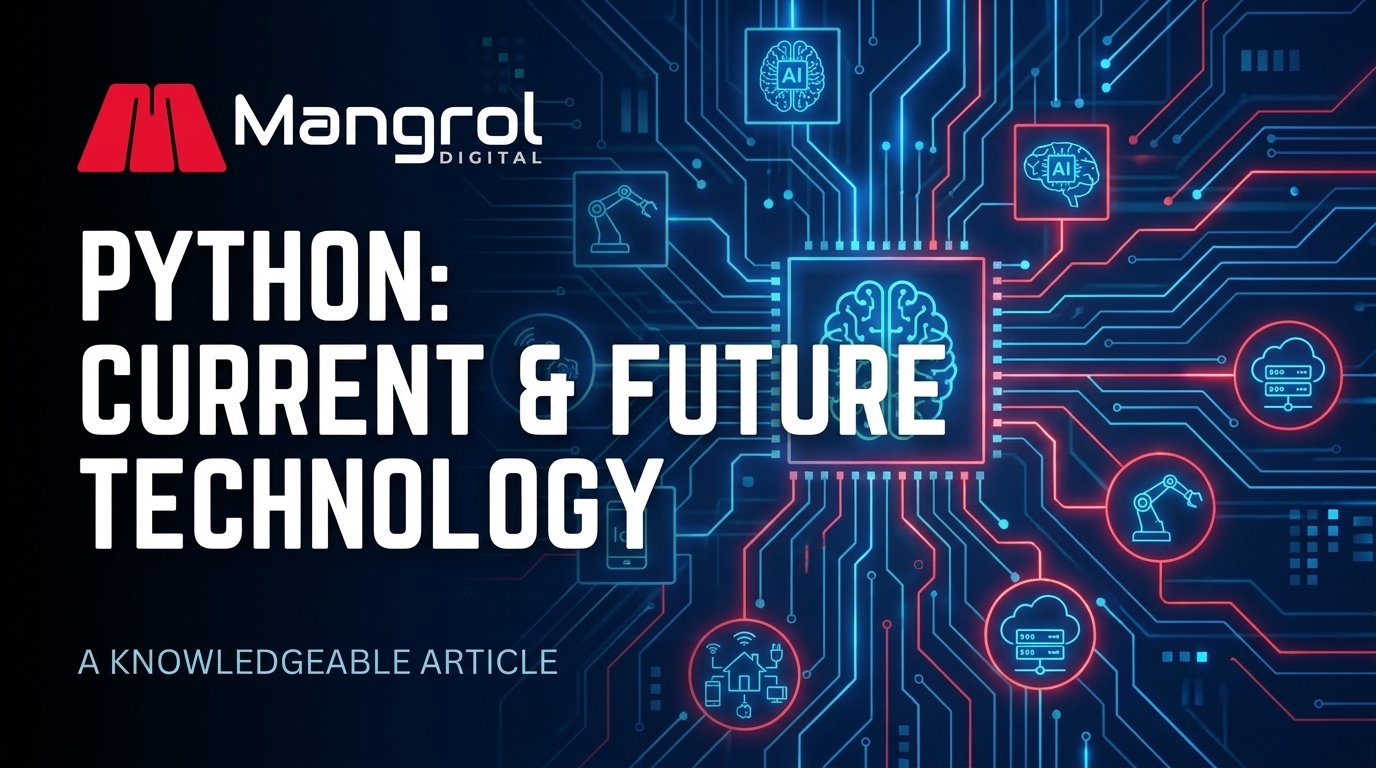
Python: The Language Powering Today's Technology and Tomorrow's Future
A Tech Insight by Mangrol Digital
If you look behind almost every major technology shaping our world today — Artificial Intelligence, Robotics, IoT, Cloud Computing — there's one language that keeps showing up: Python.
What started as a simple, beginner-friendly programming language has quietly become the backbone of the world's most advanced technology. It's not a coincidence. It's a direct result of how Python was designed — simple enough to learn quickly, powerful enough to run the world's biggest systems.
Let's break down why Python isn't just "a good language to learn" — it's becoming the language of the future.
1. Python Is the Language of Artificial Intelligence
Almost every major AI breakthrough you've heard of — from chatbots to image generators to recommendation systems — is built using Python.
Why? Because Python has:
- Powerful AI/ML libraries like TensorFlow, PyTorch, Scikit-learn, and Keras that make building AI models faster and easier
- Simple, readable syntax, so data scientists and researchers can focus on solving problems instead of fighting complicated code
- A massive community, meaning constant updates, tutorials, and ready-made solutions for almost any AI problem
Most large language models, computer vision systems, and machine learning pipelines are trained, tested, and deployed using Python. If AI is the future — and it clearly is — Python is the language building that future.
2. Python Is Driving the Robotics Revolution
Robotics used to be dominated by low-level languages like C and C++. That's changing fast.
Python is now widely used in robotics for:
- Robot Operating System (ROS) development, where Python is one of the primary supported languages
- Sensor data processing and automation logic, since Python handles data and logic clearly and quickly
- Rapid prototyping, letting robotics engineers test ideas fast before optimizing performance-critical parts in C++
From robotic arms in manufacturing to autonomous drones and self-navigating robots, Python is often the language controlling the "brain" — the decision-making layer — even when hardware-level code is written elsewhere.
3. Python Is Central to IoT (Internet of Things)
IoT is all about connecting devices — sensors, cameras, home automation systems, industrial equipment — and making them "smart." Python fits perfectly into this world because:
- It runs efficiently on small devices like Raspberry Pi and microcontrollers
- It has libraries for hardware communication (like GPIO control, MQTT, and sensor integration)
- It allows fast development of IoT dashboards and data processing pipelines
Smart homes, smart agriculture, industrial IoT, and wearable tech all rely heavily on Python for both device-side logic and cloud-side data processing.
4. Python Powers Modern Cloud Computing
Cloud platforms like AWS, Google Cloud, and Microsoft Azure all offer strong Python support — and for good reason.
Python is widely used in cloud environments for:
- Automation and scripting — managing servers, deployments, and cloud resources
- Serverless computing — AWS Lambda and Google Cloud Functions both support Python natively
- Data pipelines and big data processing — tools like Apache Airflow and PySpark are Python-based
- Building scalable backend APIs — using frameworks like Django and FastAPI
As more businesses move to the cloud, Python's role as the glue connecting applications, data, and infrastructure keeps growing.
5. Python Is Beginner-Friendly, Yet Enterprise-Powerful
One of Python's biggest strengths is that it's approachable for beginners without being "too simple" for serious, large-scale systems.
- Companies like Google, Netflix, Instagram, and Spotify use Python in their core systems
- Students and professionals can learn it quickly, making it the top choice in schools, colleges, and coding bootcamps
- It works well for everything from small automation scripts to massive AI training pipelines
This rare combination — easy to learn, yet capable of handling enterprise-scale problems — is exactly why Python's demand keeps increasing every year.
Why This Matters for the Future
Look at where technology is heading:
- AI and Machine Learning are being integrated into nearly every industry
- Robotics and automation are replacing repetitive manual work
- IoT devices are connecting homes, cities, and factories
- Cloud infrastructure is becoming the default way businesses operate
Python sits at the intersection of all four. It's not just riding the wave of these technologies — it's one of the reasons these technologies have grown as fast as they have.
Final Thoughts
Python isn't just a programming language you learn to "get started" in coding. It has become critical infrastructure for the technologies defining the next decade — AI, robotics, IoT, and cloud computing.
Whether you're a student planning a career, a business exploring automation, or a developer choosing your next skill to master, one thing is clear: Python isn't going anywhere — it's just getting started.
At Mangrol Digital, we stay closely tuned to the technologies shaping the future — because the same digital-first thinking that powers great software also powers great online growth for businesses. If you're looking to build a strong digital presence backed by real technical understanding, Mangrol Digital is here to help.